


Today, almost every company uses apps for more than simply being “present” on its customers’ phones. Apps help businesses sell, provide support, collect payments, track activity, automate internal tasks, or connect teams that once worked through disconnected processes. A banking app lets users move money in seconds; a logistics app shows where a delivery is in real time. In both cases, the application is more than a polished screen: it is a tool that changes how the business operates and delivers value.
But a successful app is not built by writing code alone. Before development begins, you need to understand the problem, design an experience that makes sense for users, define a solid technology foundation, test that everything works properly, and continue improving the product over time. That is where a specialized company brings far more value than simply providing developers.

That is why choosing an agency or company that develops mobile applications has become a strategic decision. Hiring a vendor that only delivers features is not the same as working with a technology partner that can understand your business, protect the user experience, and build a solution with real return on investment.
In this guide, we explain what an app development agency actually does, which services you should expect, how to distinguish a mobile app from a web platform, what criteria to review before hiring, and which mobile app development agencies stand out in Mexico. We will also look at why, in many projects, developing an app means thinking beyond the interface and considering the digital product and technology ecosystem that make it work.
Before Hiring an App Development Agency: Do You Really Need a Mobile App?
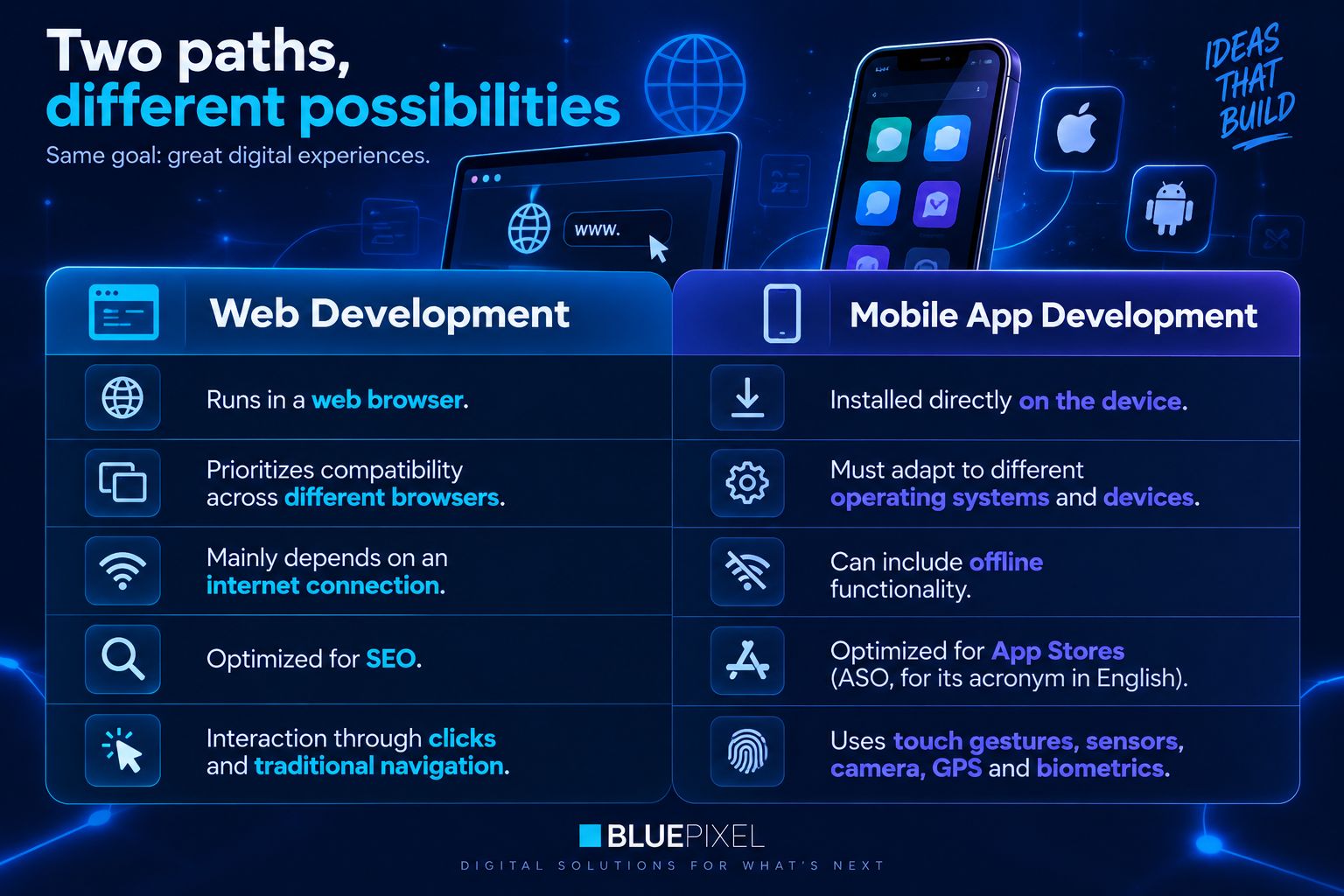
Before comparing providers, it is worth stopping to ask: does the project you have in mind need a mobile app, a web platform, or a combination of both? The answer changes the scope, investment, user experience, and the type of team you should bring in.
Web development usually works better when users need to look up information, complete occasional processes, or access the service from any browser. Mobile app development, on the other hand, makes more sense when the experience needs to use device-specific capabilities such as notifications, geolocation, the camera, biometrics, or offline functionality.
But it is not always a matter of choosing one or the other. Some projects need an omnichannel experience in which the web, mobile app, and other touchpoints connect to the same systems, data, and processes to provide users with a consistent experience.
What If You Need Both?
In an omnichannel experience, the app and web platform can serve as different access points to the same digital product. For example, a user can start a process on the web, continue it in the app, and receive personalized information without losing continuity across channels.
For some projects, combining both channels creates a more consistent and seamless experience, especially when users interact with the service through different touchpoints.
The decision should not start from the idea that “apps are trendy,” but from how users need to interact with the product. An app makes more sense when interactions are frequent, device-specific capabilities are required, or the experience needs to support users in real time.
An App Is More Than an Interface: The Technology Ecosystem Behind It
When we talk about app development, the application the user interacts with is only the visible part of the solution. Behind it, different systems and technologies may be working together so the experience functions properly, processes information, and connects with business operations.
Depending on the project, an app may integrate with elements such as:
- CRM or ERP systems
- APIs and databases
- payment platforms
- internal systems
- analytics tools
- automations
- artificial intelligence solutions
- cloud infrastructure
For example, an app may show a user the status of an order, while that information actually comes from inventory, logistics, and payment systems operating behind the interface.
That is why, when choosing an app development agency, you should evaluate not only its ability to build the mobile experience, but also its ability to design and integrate the technology ecosystem the product needs.
👉 You may also be interested in: How to Know Whether a Mobile App Is Right for Your Business: Advantages and Disadvantages
When an App Can Create Real Business Value
Developing an app makes sense when it solves a specific problem, improves a process, or creates an experience that takes advantage of device capabilities. Features such as push notifications, geolocation, the camera, biometrics, or offline access become valuable when they are connected to a real business or user objective.
In practice, there are several scenarios in which a mobile application can become an important part of the digital product:
Digitize Internal Processes
Companies in industries such as manufacturing, logistics, and construction use apps to capture field information, manage inventory, oversee operations, or collect evidence without relying on manual processes.
Improve the Customer Experience
Retailers, banks, insurers, and service companies use applications to simplify purchases, inquiries, payments, reservations, order tracking, or personalized support.
Create New Business Models
Many startups build entire business models around mobile applications, from mobility platforms to marketplaces, fintech solutions, and on-demand services.
Increase Customer Loyalty
Loyalty programs, rewards, exclusive content, and personalized experiences help strengthen customer relationships and encourage repeat engagement.
Use Data to Make Better Decisions
Applications generate valuable information about behavior, preferences, and usage patterns that can be used to optimize products and processes.
Types of Mobile Applications an Agency Can Develop
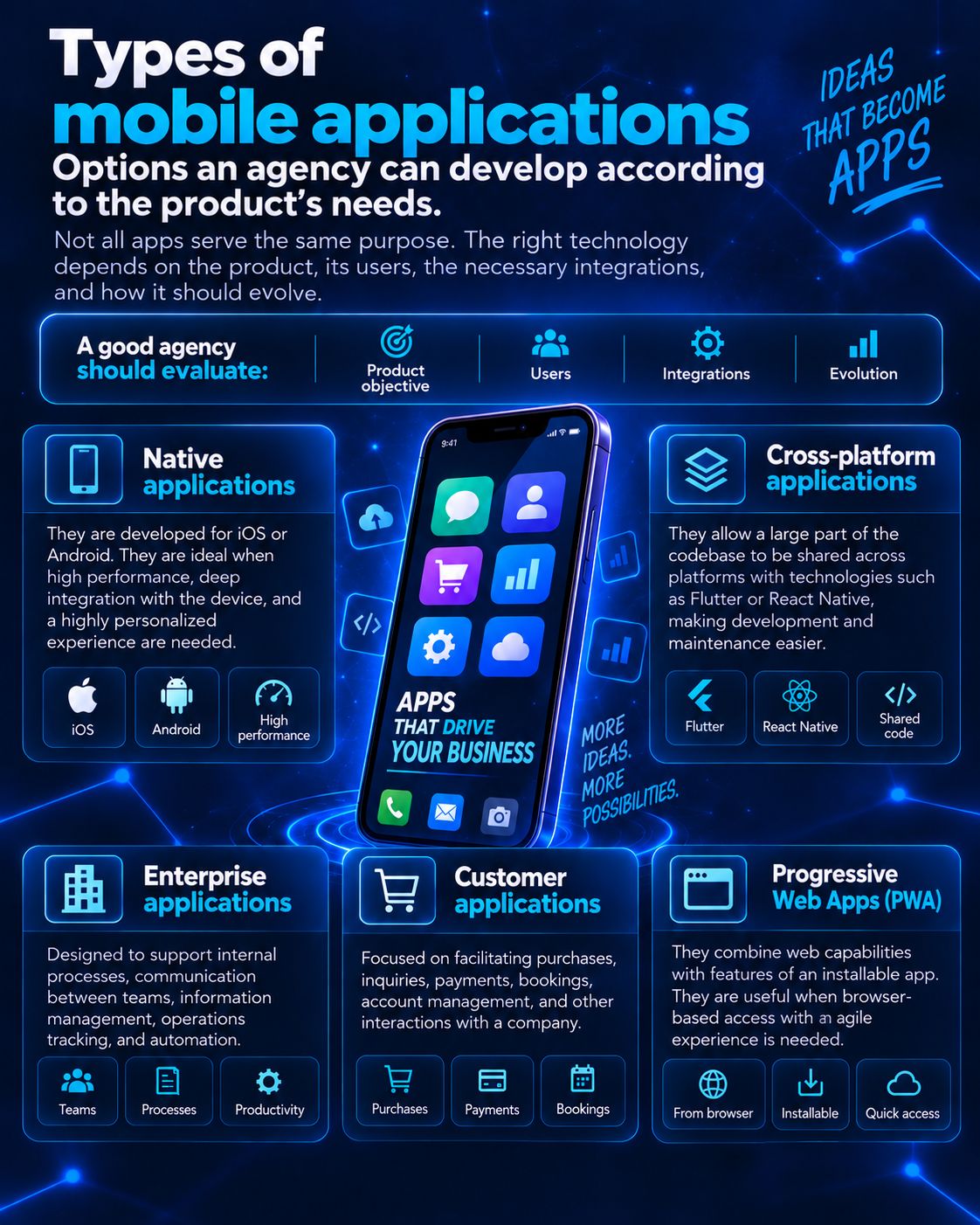
Not all mobile applications serve the same purpose or require the same approach. The choice between a native app, a cross-platform app, or an installable web solution should be based on the product’s needs, its users, the required integrations, and how it will need to evolve.
An app development agency should be able to evaluate these variables before recommending a technology.
Native Applications
These are developed specifically for iOS or Android using technologies designed for each platform. They are a good option when the project requires high performance, deep integration with device capabilities, or a highly customized experience.
Cross-Platform Applications
These allow much of the codebase to be shared across operating systems using technologies such as Flutter or React Native. They can simplify development and maintenance when functionality and experience are similar across platforms.
Depending on their purpose, applications can also include:
Enterprise applications:
Designed to support internal processes, communication between teams, information management, operations tracking, or automation.
Customer-facing applications:
Designed to simplify purchases, inquiries, payments, reservations, account management, or other forms of interaction with a company.
Progressive Web Apps (PWAs)
These combine web capabilities with some features of an installable application. They can be an alternative when the project needs a browser-accessible experience without necessarily developing a native app.
👉 You may also be interested in: Mobile Web Apps vs. Native Apps: Key Differences, Examples, and Advantages
What an App Development Agency Should Offer
If developing a mobile app makes sense for your business, the next step is to evaluate what the company behind the project can bring to the table. A good app development agency should do more than code features; it should support the product from problem definition through its evolution after launch.
That means bringing together different capabilities: product strategy, user research, UX/UI, technology architecture, development, integrations, QA, data, and artificial intelligence when the project requires it.
Rather than hiring isolated services, it is better to look for a team that understands how these disciplines work together throughout the product lifecycle.
1. Discovery and Product Strategy: Define What to Build and Why
Every strong app starts with business questions, not technology questions. Before designing screens or writing code, the agency needs to understand what problem you want to solve, who you are solving it for, what the priorities are, and how success will be measured.
During the discovery stage, the team seeks to understand questions such as:
- What problem will the application solve?
- Who will its users be?
- How does it connect to the business objectives?
- Which metrics will measure success?
- Which features are truly a priority?
The goal is not to fill pages with documentation, but to create clarity before the project begins.
When this stage is skipped, projects often face constant scope changes, cost overruns, or features that nobody ends up using.
2. User Research (UX Research)
Once the objective is defined, research helps compare the internal vision with what users actually need. This is where friction points, habits, expectations, and opportunities emerge that are not always obvious from the boardroom.
Specialized companies use different methods to understand user behavior, including:
- Interviews
- Surveys
- Market research
- Competitor analysis
- Experience maps
- User personas
- Customer journey maps
- Behavior analysis using analytics tools
With this information, the team can prioritize useful features and remove friction from the earliest stages of the project.
👉 You may also be interested in: User Experience (UX) Research: Everything You Need to Know
3. UX/UI Design
With that information, user experience and interface design turn strategy into a tangible experience: flows, information architecture, wireframes, interfaces, and prototypes that make it possible to validate the app before fully investing in development.
The best agencies validate these prototypes with real users to identify improvements before investing development time.
4. Technology Architecture: Build a Foundation That Can Scale
An app may work well at first, but the technology platform supporting it needs to be ready to grow with it.
As users, transactions, or integrations increase, poorly designed architecture can become a constraint on the product’s evolution. That is why technology architecture is not a minor technical detail: it is the foundation that allows the product to scale without becoming fragile or expensive to maintain.
This is where elements such as the following are defined:
- Infrastructure
- APIs
- Databases
- Security
- Scalability
- Integrations
- Authentication
- User management
- Storage
Well-designed architecture makes it easier for the product to evolve and reduces maintenance costs.
5. Frontend and backend development: turn the design into a functional platform
An application needs the user-facing experience and the logic operating behind it to work together seamlessly.
The frontend covers the interface, navigation, and user interactions, while the backend manages elements such as data, business rules, authentication, security, and integrations.
An app development agency should be able to work across both layers together to ensure the experience is stable, scalable, and able to integrate with the systems the business needs.
6. Integrations: Connect the App to the Business Ecosystem
An application rarely operates in isolation. To fulfill its purpose, it may need to connect with systems such as CRM, ERP, payment platforms, inventory systems, analytics tools, authentication services, or other internal solutions.
That is why an app development agency should also be able to design and implement these integrations reliably and securely so the application can exchange information with the rest of the business’s technology ecosystem.
7. QA and Testing: Catch Errors Before They Reach Users
A functional app is not necessarily an app that is ready to launch. Before publishing it, you need to validate that it works correctly across different devices, usage conditions, and real-world scenarios.
A QA strategy may include testing for:
- functionality
- cross-device compatibility
- performance
- security
- accessibility
- usability
- manual and automated testing
The goal is to catch errors before they affect end users and reduce risk during launch and product operations.
8. Launch, Support, and Continuous Evolution
Development does not end when the application reaches the App Store or Google Play. Launch marks the beginning of a new stage in which real product usage generates information that can be used to keep improving it.
Support and evolution may include:
- performance and usage monitoring
- issue resolution
- experience optimization
- security and compatibility updates
- new feature development
- metric tracking
An app should not be designed with the idea of reaching a final version, but rather to evolve based on what users do and need. Usage data can reveal opportunities, show what works, and help prioritize new capabilities as the business and market change.
9. Data and Artificial Intelligence: New Capabilities for the App
An app can also become a source of data about how users interact with the product. Analyzing that information makes it possible to identify usage patterns, spot friction, and find opportunities to improve the experience.
Depending on the project, artificial intelligence can add capabilities such as:
- in-app assistants;
- process automation;
- semantic search;
- conversational interfaces;
- predictive analytics;
- behavior-based personalization.
The value does not come from adding AI because it is trendy, but from using it when it helps solve a user or business need more effectively. In those cases, the app stops being just an interface and can become an intelligent interaction layer connected to business data and systems.
Technologies for Developing Mobile Apps: How to Choose Without Following Trends
There is no single ideal technology for every project. The decision should start with what your digital platform needs to accomplish: the type of experience, expected performance, integrations, security, budget, timeline, and growth plans.
Depending on the project, an agency may recommend native technologies for iOS or Android, cross-platform frameworks such as Flutter or React Native, and different solutions for the backend and cloud infrastructure.
What matters is not choosing a technology because it is popular, but understanding that some technologies are better suited to certain needs and will allow the application to evolve over time.
That is why, when evaluating an app and digital product development agency, you should ask not only which technologies it uses, but how it decides which one to implement for each project and what that decision will mean for performance, maintenance, scalability, and integrations.
How to Choose a Mobile App Development Company
When choosing a mobile app and digital product development company, you should not focus only on comparing prices or technologies. It is worth evaluating whether the team understands the business problem, has experience with products of similar complexity, and can support the project from strategy and design through development, integrations, and post-launch evolution.
Before hiring, pay particular attention to the following:
Do They Understand the Business, or Do They Only Talk About Technology?
A good service provider takes the time to understand your processes, objectives, and users before proposing solutions.
Do They Have Experience With Similar Projects?
Review case studies related to your industry or to products with a comparable level of complexity.
How Do They Design the User Experience?
Ask to see their UX and UI methodology. Remember that even a technically flawless application can fail if it is difficult to use.
How Scalable Are Their Solutions?
Ask how the solution is designed to handle growth in users, new features, integrations, or changes to the business model.
What Happens After Launch?
Ongoing product support is just as important as the initial development.
Make sure you understand:
- response times
- maintenance model
- updates
- monitoring
Post-launch support is key to learning from real usage, addressing friction points, and prioritizing new capabilities as the product evolves.
This approach to continuous evolution is part of BluePixel’s Futureproof philosophy: building products that can adapt as users, technology, and business needs change.
How Transparent Is Their Process?
The best agencies work with clear roadmaps, regular reviews, sprint demos, collaborative tools, and shared metrics.
Visibility into the project reduces risk and makes decision-making easier.
Before signing, it is also worth asking for concrete deliverables: a documented discovery process, an initial roadmap, validated prototypes or flows, security criteria, an intellectual property framework, an analytics plan, and an ongoing support model. These are not mere formalities; they are signs that the agency is thinking about the product beyond the first delivery and has a process for reducing risk throughout development and evolution.
Common Mistakes When Hiring an App Development Company
Many problems in an app development project are not caused by the chosen technology, but by decisions made before and during development: choosing the wrong provider, defining the scope poorly, or failing to involve users.
These are some of the most common mistakes.
Choosing Based on Price Alone
A suspiciously low-cost proposal may leave out important stages such as research, design, validation, architecture, or post-launch support.
Rather than looking for the lowest cost, evaluate the value the product can create for you over the next several years.
Assuming All Agencies Do the Same Thing
Not all agencies have the same capabilities or are prepared for the same type of project. Some specialize in technical execution; others combine product strategy, UX, engineering, data, or continuous evolution. Rather than choosing the largest or best-known company, it is better to look for the partner that best fits the problem and the type of product you need to build.
Failing to Involve Users
Many applications are designed based solely on internal opinions, only for teams to later realize that without research or validation they developed features users never adopt.
Trying to Include Everything in the First Version
One of the most expensive mistakes is trying to launch an application with every feature imaginable.
A well-defined MVP makes it possible to validate hypotheses quickly and evolve based on real feedback, rather than spending months on features that may not be a priority.
Neglecting Maintenance
An app needs maintenance and evolution because the context changes: iOS and Android are updated, new devices appear, user expectations shift, and new business needs emerge. Without ongoing attention, even a well-built product can lose relevance or performance over time.
Best App Development Agencies in Mexico
Before reviewing specific names, one point is worth clarifying: the best agency is not always the largest, the cheapest, or the one that promises the fastest delivery. The best option is the one that understands your problem, has experience with similar products, and can support your project with a business, design, and technology perspective.
Mexico has a growing ecosystem of companies specializing in software and mobile app development. However, they do not all offer the same approach, experience, or level of specialization.
Below are several companies recognized for their track record, technical capabilities, and experience developing digital products for organizations of different sizes.
Editorial note: This selection is intended for informational purposes and considers factors such as experience, portfolio, specialization, working methodologies, and market presence. The order does not represent a ranking, since the best option depends on the needs and characteristics of each project.
BluePixel
At BluePixel, we are specialists in UX/UI design, software development and digital platforms, and we support organizations looking to build, evolve, and scale their digital products.
Our approach combines product strategy, UX research, user research, UX/UI design, technology development, and continuous evolution. This allows us to support projects from the discovery stage through long-term growth with our Futureproof philosophy, which helps guide the evolution of your digital products using real data, user research, and a results-driven roadmap.
We stand out in particular for bringing together UX, engineering, data, and artificial intelligence within a single working model.
Ideal for: companies looking for a long-term technology partner and projects where user experience is a critical factor.
Softtek
Softtek is one of the largest technology companies in Latin America and offers software development, digital transformation, infrastructure, and consulting services for large organizations.
Ideal for: large-scale enterprise projects.
Wizeline
Wizeline develops digital products, artificial intelligence-based solutions, and technology platforms for international companies.
Its experience spans industries such as healthcare, fintech, and e-commerce.
Ideal for: organizations with complex digital products and an international presence.
Improving Nearshore (formerly Improving)
Specialized in software engineering and dedicated teams for companies that need to accelerate digital product development.
Ideal for: companies looking to expand their technical capabilities through specialized teams.
Distillery
A company focused on software development, mobile applications, and engineering teams for startups and technology organizations.
Ideal for: companies with growing digital products.
Frequently Asked Questions About Agencies and Mobile App Development
How Much Does It Cost to Develop a Mobile Application in Mexico?
There is no single cost. The budget depends on factors such as functional complexity, number of platforms, integrations, UX/UI design, infrastructure, and the required support. That is why an agency will usually begin with a discovery stage to define the scope before preparing an accurate estimate.
How Long Does It Take an Agency to Develop an App?
The timeline depends on the scope and complexity of the product. An MVP may take several months, while an enterprise platform with multiple integrations may require a longer development period. The important thing is to work in stages that make it possible to validate and adjust the product throughout the process.
Is It Better to Develop a Native App or a Cross-Platform App?
It depends on the project’s needs. Native applications generally offer deeper integration with the device, while cross-platform solutions can simplify development and maintenance when requirements are similar for iOS and Android.
A good agency should justify the technology choice based on the product, not on trends or internal preferences.
What Is the Difference Between a Mobile Application and a Web Application?
A web application runs in a browser and does not require installation. A mobile application is installed on the device and can use capabilities such as GPS, the camera, push notifications, biometrics, or local storage.
What Maintenance Does a Mobile App Need After Launch?
After launch, an app needs technical maintenance and continuous evolution. This may include security updates, compatibility with new versions of iOS and Android, performance optimization, monitoring, issue resolution, and new features based on real product usage.
How to Choose the Best App Development Agency for Your Project
Choosing an app development agency is not simply about finding a team that can code. The decision should start with something more important: what business problem you need to solve and what type of digital product can solve it sustainably.
Companies that achieve the best results work with multidisciplinary teams that combine product strategy, UX Research, UX/UI design, technology architecture, development, integrations, data, and continuous evolution. This combination helps reduce risk, validate decisions before overinvesting, and build products that can adapt as users and the business change.
Rather than looking for a finished app, it is better to think in terms of a digital product that can learn, improve, and evolve over time.
At BluePixel, we help companies turn complex problems into digital products and platforms through product strategy, UX Research, UX/UI design, technology development, and continuous evolution.


.png)