



In the Mexican business ecosystem, the question “How much does it cost to develop an enterprise app in Mexico?” has evolved. It is no longer simply an operating expense or an “extension of the website,” but the creation of a digital asset capable of optimizing supply chains, building customer loyalty through personalized experiences, and generating valuable data streams for real-time decision-making.
According to an analysis by Spherical Insights, the enterprise app market is expected to reach 20.93 billion dollars by 2033, making this segment an extremely valuable business opportunity.
That was the approach behind the RadioShack app.
The market in Mexico offers a unique competitive advantage: significantly lower development costs than in the United States or Europe, but with world-class engineering and design standards. However, taking on a project of this scale without a clear understanding of the financial variables can lead to underestimating the effort required or compromising the quality of the solution. Understanding the cost of an app requires looking beyond lines of code; it means evaluating architecture, information security, long-term scalability, and the strategic role it plays among a company’s assets.
How much does it cost to build a mobile app?
The answer is "it depends." The cost of an application is directly related to its functional scope and the infrastructure needed to support it. Based on recent projects, these are, broadly speaking, some investment ranges for creating an application:
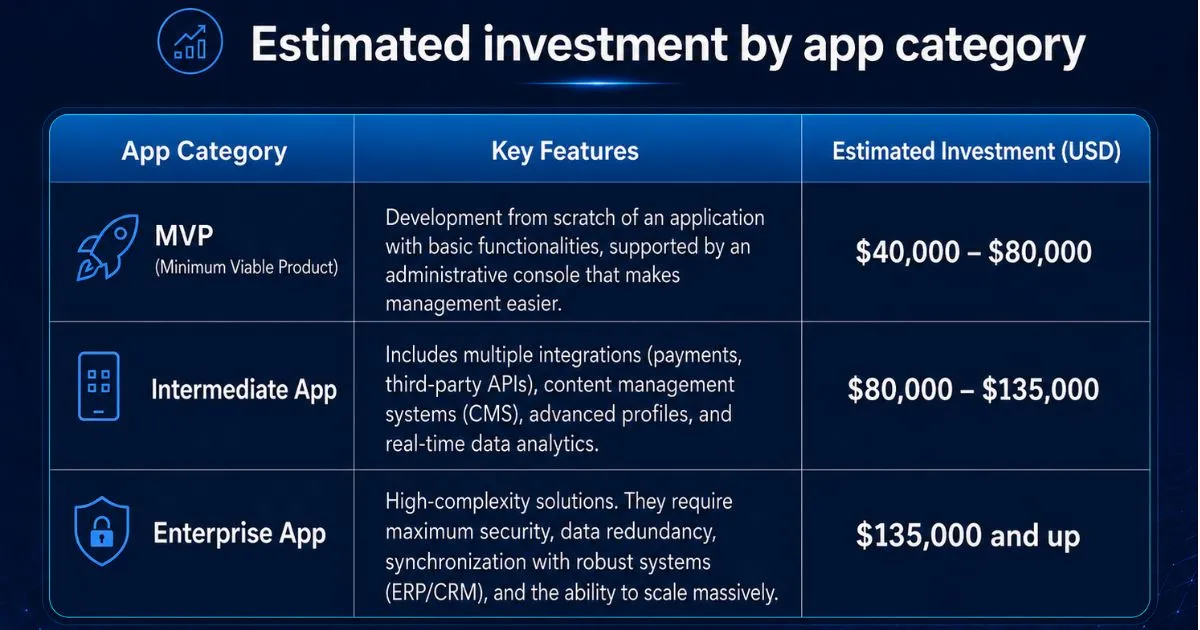
To understand why an app can reach these investment levels…, it is necessary to analyze the technological pillars that support development:
Architecture and selected technology
Native development involves creating two independent applications: one for iOS in Swift and another for Android in Kotlin. Although it offers the highest performance and full access to hardware capabilities, it essentially requires doubling the development team.
Hybrid/Cross-platform development: Technologies like React Native make it possible to share a large portion of the code. This can optimize the initial investment by up to 30% and simplify future maintenance, making it the preferred option for many companies seeking agility without sacrificing quality.
Features and technical complexity
The cost does not increase because of the number of screens but because of the business logic behind them. Features such as real-time asset geolocation, artificial intelligence-based recommendation engines, bank-grade encryption systems, or the ability to work offline with later synchronization require hundreds of hours of specialized engineering.
User Experience (UX) and Visual Design (UI)
An application must be intuitive to reduce the learning curve for employees or friction for customers. This requires a deep process of prototyping, usability testing, and interface design that respects brand identity, ensuring that the tool is not only powerful but also easy to use.
“It is not just about building the asset; it has to be maintained.”
Launching the application is only the beginning. Software is a living organism. It is estimated that each year, between 15% and 20% of the initial cost should be invested to update the app for new operating system versions (iOS/Android), fix potential bugs, and optimize performance.
How do I choose the ideal partner to develop an app?
The success of a project of this scale depends on who executes it. While a freelancer may seem attractive from a cost perspective, companies usually choose specialized agencies or consulting firms that guarantee:
- Project continuity: Long-term technical support.
- Intellectual property: Contracts that ensure the source code and all assets belong to the company.
- Agile methodologies: Continuous delivery processes that allow real progress to be seen every few weeks.
Determining the cost of a mobile application is only half of the equation; the true measure of success is the value it generates for the organization. A well-executed application should not only meet technical standards but also be designed to scale. The recommended approach for any company, regardless of its size, is to start with a robust, high-quality MVP.
This path allows executive leadership to measure return on investment in early stages, learn from user behavior, and expand the platform’s capabilities organically and in a financially responsible way. Ultimately, the cost of “not innovating” or launching a poor-quality tool is usually much higher than the initial investment in professional, well-structured development. Today, more than ever, the app is the digital face of your company’s operational excellence.
Do you need an app that scales at the same pace as your business? Send us a message.


.png)