
Investment in artificial intelligence continues to grow, but its profitability is starting to raise concerns among companies and investors. Developing more advanced solutions, adopting new models, or expanding computing capacity does not guarantee that these investments will deliver financial returns.
This issue is already visible in the technology infrastructure market. On October 26, 2026, companies such as CoreWeave, Nebius, and IREN saw further declines in their stock prices amid concerns about the debt levels and financial sustainability of neoclouds, specialized providers of computing capacity for artificial intelligence.
The trend, documented by CNBC and analyzed by Capacity, highlights a challenge that also affects organizations implementing these technologies: investing in artificial intelligence does not necessarily produce a positive return on investment.
According to Gartner research published in October 2026, only 13% of surveyed CIOs said their organizations had realized significant or transformative value from AI.
Why do so many companies still struggle to recoup their investments, and what can they do to achieve measurable financial results?
What Does Neocloud Consolidation Reveal About Enterprise AI Profitability?
Neoclouds are cloud infrastructure providers that specialize in offering computing capacity through graphics processing units (GPUs), which are used to train and run artificial intelligence models.
Their growth has been driven by demand for computing resources from technology companies, model developers, and organizations that need to run AI applications at scale.
However, this infrastructure requires substantial investments in hardware, data centers, electricity, and cooling systems. Providers must also recover their capital before their equipment becomes less competitive than newer generations of processors.
Growing demand does not eliminate these financial risks.
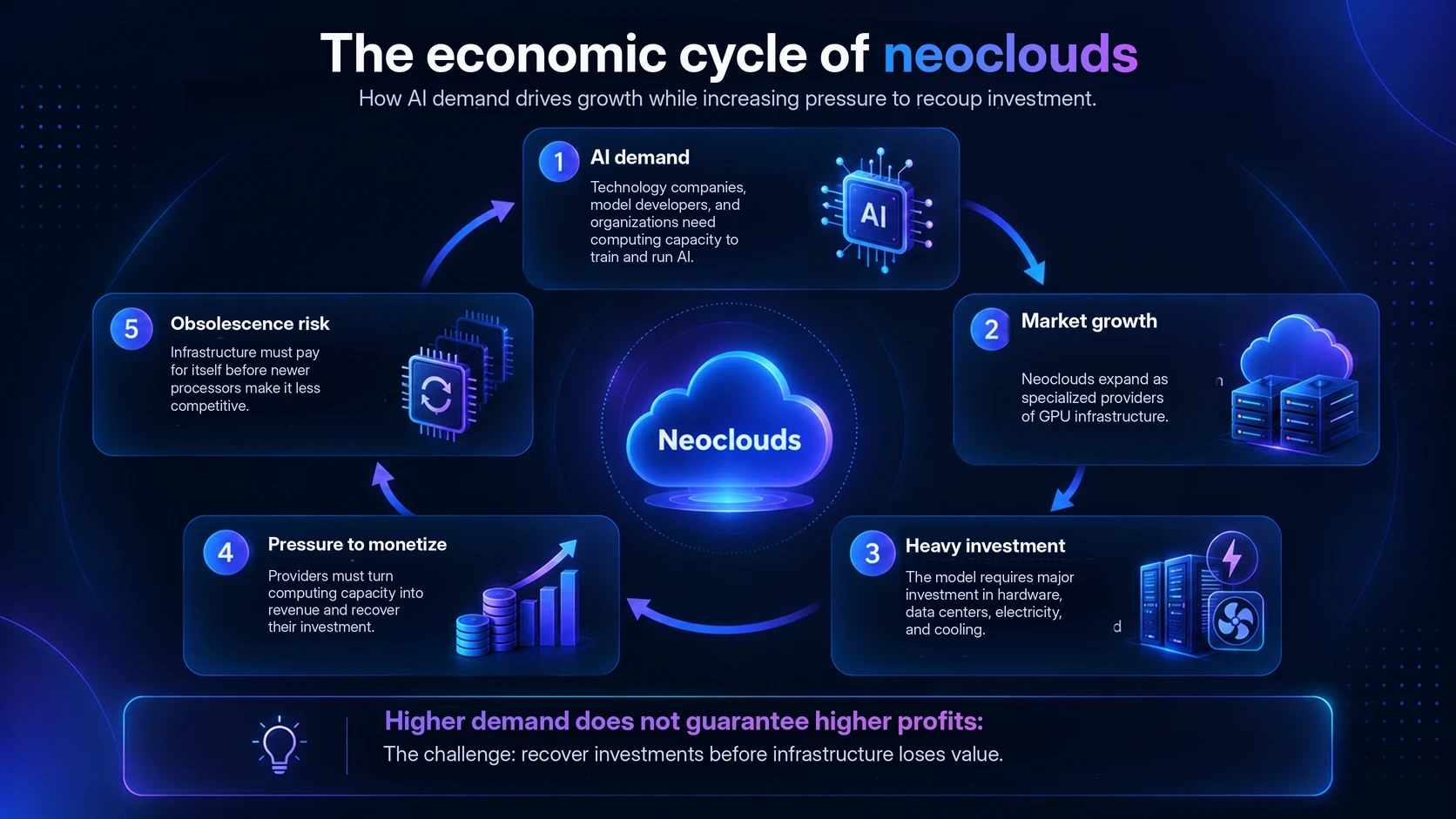
According to Gartner, more than $3.5 trillion in AI infrastructure investments could be exposed to impairment by 2030 if providers maintain their current spending pace.
The firm also projects that more than 80% of neoclouds will cease operating independently by 2030 because of financial pressures and a lack of sufficiently differentiated business models.
This does not mean they will all go bankrupt. Consolidation can also take place through acquisitions or mergers.
For companies using AI services, this scenario raises three important considerations:
- Infrastructure costs: Prices and commercial terms may change as the provider market evolves.
- Technology dependency: Relying on a single provider can make migration more difficult if its operating or commercial conditions change.
- Project profitability: Buying more computing capacity does not guarantee proportional improvements in productivity, revenue, or efficiency.
Although the financial challenges facing neoclouds differ from those companies encounter when implementing AI, both highlight the importance of linking technology investments to sustainable financial outcomes.
Why Are Companies Struggling to Achieve a Positive ROI From AI?
McKinsey’s report The State of AI in 2026: On the Road to ROI found that nearly nine in ten respondents reported using AI regularly in at least one business function. However, only 37% attributed any positive impact on their companies’ operating results, measured by EBIT, to these technologies.
The gap between adopting artificial intelligence and achieving financial benefits also appears in Boston Consulting Group’s study The Widening AI Value Gap. In its 2025 research, BCG found that 60% of the companies analyzed generated little or no material value from their AI investments, while only 5% were generating value at scale.
Although the studies use different samples and methodologies, both point to the challenges of turning technology adoption into business results.
Several factors influence return on investment when companies implement AI. Below are five of the most common.
1. Implementing AI Without Clear Business Goals or Profitability Metrics
One of the costliest mistakes is adopting artificial intelligence without identifying the business problem it needs to solve.
An organization may subscribe to virtual assistants, develop intelligent agents, or purchase automation platforms without first establishing the cost of the process it wants to improve.
For example, a company looking to automate sales support might introduce a chatbot before assessing how many inquiries it receives, how long it takes to respond, or what percentage becomes a sales opportunity.
Even if the chatbot works properly, the company would lack enough information to determine whether its implementation reduced costs, increased revenue, or improved the customer experience.
This problem also arises when companies use activity metrics as substitutes for financial outcomes. The number of tool interactions, documents generated, or employees using a solution does not, by itself, prove that a project is profitable.
How Can Companies Avoid This?
Before investing, companies need a business case that compares their current operations with the benefits the implementation could deliver.
In sales support, for example, relevant metrics may include cost per inquiry handled, conversion rate, response time, and revenue attributable to the opportunities generated.
Enterprise AI consulting can help assess existing processes, identify opportunities, and prioritize projects based on their potential financial impact.
Identifying opportunities also means understanding which processes can genuinely benefit from these technologies. In our article on how to turn AI into a business opportunity, we discuss different enterprise applications and the factors worth considering before implementation.
Investment decisions should begin with the problem to be solved, not the tool available.
2. Failing to Calculate the Total Cost of Implementing and Maintaining AI
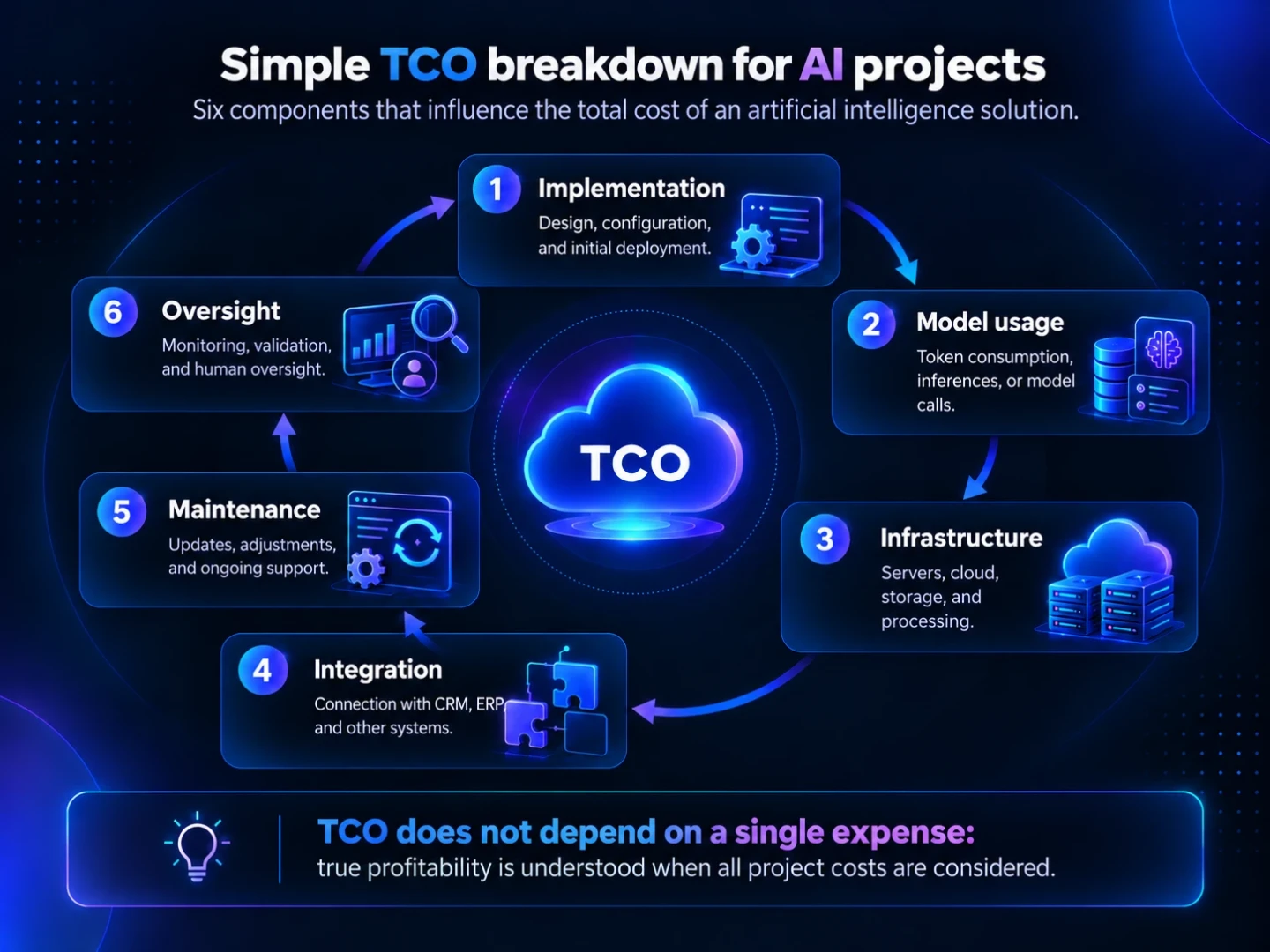
The initial cost of an AI solution represents only part of the investment required to use it.
Beyond development or procurement, companies must account for infrastructure, model usage, storage, systems integration, oversight, security, and maintenance.
Some of these costs can rise as the number of users, queries, or automated processes increases.
This explains why a solution that appears financially viable during testing can become expensive once it is rolled out across an entire organization.
For example, an AI agent processing customer requests may require more computing capacity, database queries, and human oversight as its workload grows.
The issue becomes more significant when the benefits do not increase at the same rate.
Operating Costs Are Already Limiting Enterprise Adoption
In its August 2026 research, McKinsey found that approximately 20% of respondents reported limiting AI use because of operating costs, including those associated with token consumption.
Gartner, meanwhile, found that 51% of surveyed CIOs expected artificial intelligence to increase the total cost of ownership of their technology solutions.
Total cost of ownership (TCO) includes all the resources needed to acquire, implement, operate, and maintain a solution over a defined period.
How Can Companies Avoid This?
Companies should calculate TCO before beginning a project and update it as operating conditions change.
Factors to consider include development costs, licensing, data processing, integrations, maintenance, and the human resources required to oversee operations.
It is also worth comparing different technological alternatives. Not every problem requires advanced models or autonomous agents. Some tasks can be addressed through conventional automation at lower cost, with similar results.
The choice should account for both the technology’s capabilities and the financial benefits it can deliver.
AI consulting for your business can help clarify these questions and prevent unforeseen expenses later on.
3. Implementing AI Without Integrating Enterprise Data and Systems
Artificial intelligence needs reliable information to participate effectively in business processes.
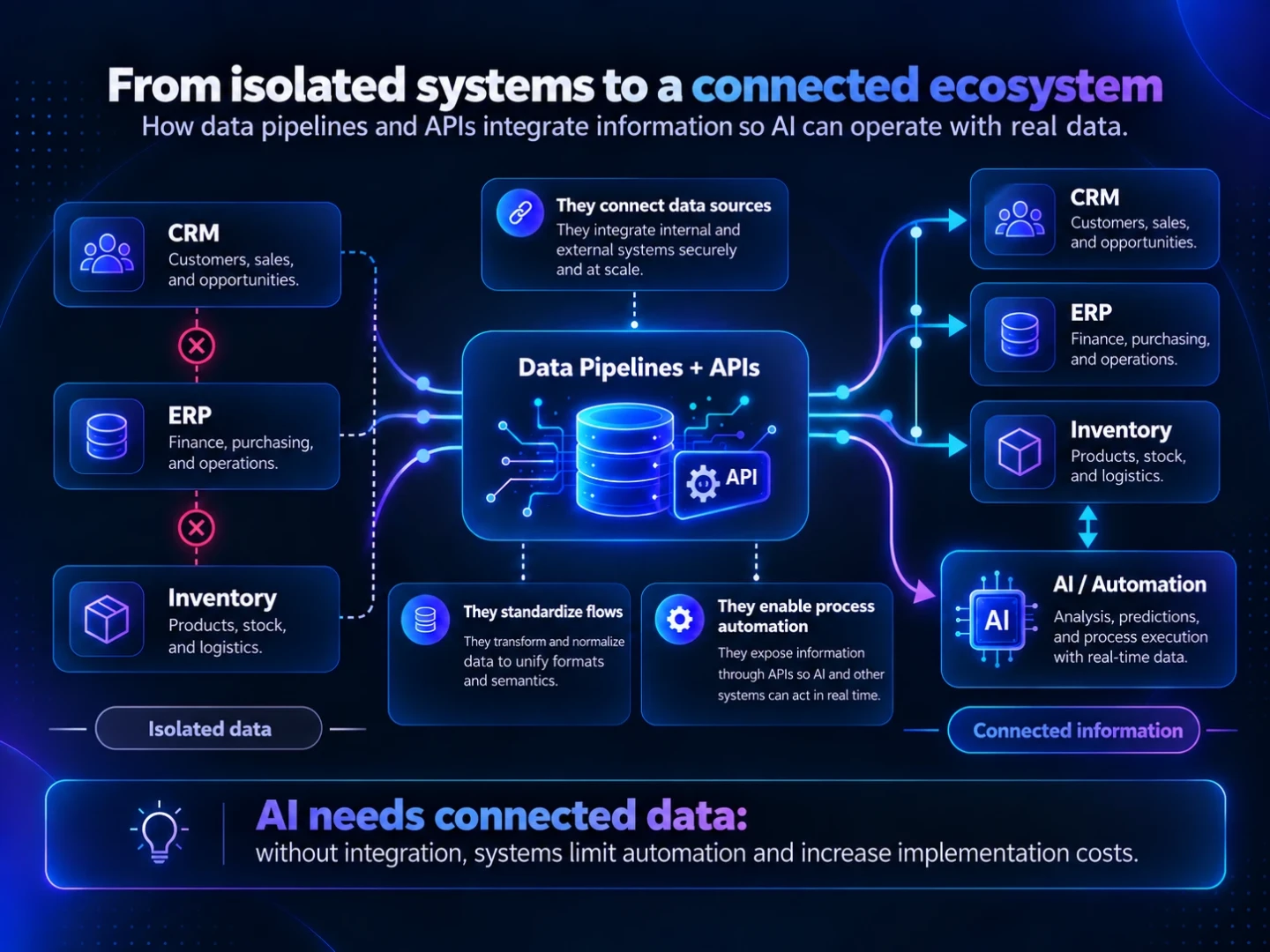
Yet many organizations keep their data spread across platforms that do not communicate with one another: administrative systems, CRM and ERP software, spreadsheets, and applications developed for specific needs.
This fragmentation can increase implementation costs and limit the operations an AI solution can perform.
Consider a company that wants to use AI agents to automate order processing.
If inventory is managed in one platform, purchase orders in another, and customer information in a separate system, the solution must access several sources to complete each transaction.
When information is outdated or inconsistent, this can lead to order errors, duplicate records, and decisions based on incorrect data.
In this situation, the company ends up spending part of its AI budget on integration problems that existed before the technology was implemented.
How Can Companies Avoid This?
Before developing a solution, companies need to assess the quality, availability, and structure of their business data.
This helps establish what information the system needs, where it comes from, and how it should be updated.
In some cases, connecting existing applications through APIs will be enough. In others, processes are needed to organize, transform, and distribute information across different platforms.
Data pipelines can integrate enterprise information and create data flows that support analytics systems, automation, and other applications.
Once these connections are in place, AI agents and enterprise automation systems can use information from existing platforms to perform tasks, retrieve records, and participate in operational processes.
This makes it possible to build on the existing technology infrastructure without necessarily replacing every system in the organization.
4. Investing in AI Pilots That Never Reach Production
Developing a working AI proof of concept does not mean the solution is ready for use in day-to-day business operations.
Pilots typically use selected datasets, controlled scenarios, and a limited number of users.
Moving a project into production introduces new requirements for security, integration, performance, availability, and maintenance.
A tool that performs well in a demonstration may need substantial changes before it can support hundreds or thousands of real-world transactions.
Financial problems emerge when companies keep funding these projects without setting criteria for deciding whether to move forward, revise them, or stop them.
Why It Matters to Know When to Stop a Project
Gartner’s October 2026 research found that organizations with defined criteria for deciding when an AI pilot should not move into production were 2.3 times more likely to be among the companies reporting better business outcomes and higher CEO-perceived value from AI.
However, only 31% of surveyed CIOs reported having such criteria in place.
This relationship does not mean that setting rules guarantees profitability, but it highlights the importance of managing investments throughout a project’s lifecycle.
How Can Companies Avoid This?
Each pilot should begin with operational goals, technical requirements, and expected financial outcomes.
For example, a company developing automation for financial reconciliations could track the percentage of transactions processed correctly, the hours of oversight required, and the cost per reconciliation.
If the solution meets its targets, the company can consider a phased rollout. If it requires too much manual intervention or costs more than the expected benefits, it should be revised or its viability reconsidered.
Integration should also be considered from the earliest stages.
Rather than developing tools that work only in isolated scenarios, companies can design AI-agent automation and integration projects that connect to enterprise platforms and execute processes as part of daily operations.
5. Implementing AI Without Redesigning Processes or Preparing Employees
The profitability of an artificial intelligence solution also depends on how it is used within an organization.
A company can introduce advanced tools while leaving its working procedures almost unchanged.
Consider a system that generates financial reports in minutes. If those documents must then go through the same manual review, data entry, and approval processes, some of the time saved may be lost to activities that have not changed.
The technology improves one task, but the overall process remains inefficient.
A difficult-to-use solution may also encounter resistance from employees, particularly when it adds steps or fails to provide sufficiently reliable information.
Adoption Affects Financial Outcomes
McKinsey’s 2026 study found that nearly three-quarters of the organizations achieving the strongest AI results had fundamentally redesigned their workflows.
By comparison, only about one-quarter of the remaining respondents reported similar changes.
The difference suggests that creating value with artificial intelligence requires rethinking how work gets done and how employees interact with the tools.
How Can Companies Avoid This?
Companies need to involve users from the early stages of development, identify the obstacles they face, and design solutions that genuinely make their work easier.
Training should also be accompanied by methods for measuring usage and results.
In this context, measuring user experience with data can help identify navigation problems, usability issues, and opportunities for improvement.
Metrics may include adoption rates, task completion rates, errors, time required to complete activities, and user satisfaction.
Success, however, should not be measured solely by how many people use a tool, but by the benefits that its use brings to the organization.
How to Calculate the Return on Investment of an AI Project
To determine whether a solution is profitable, companies need to compare its financial benefits with the total cost of implementing and operating it.
Return on investment, or ROI, expresses this relationship as a percentage.
The basic formula is:
ROI (%) = [(Financial benefits obtained − Total investment cost) / Total investment cost] × 100
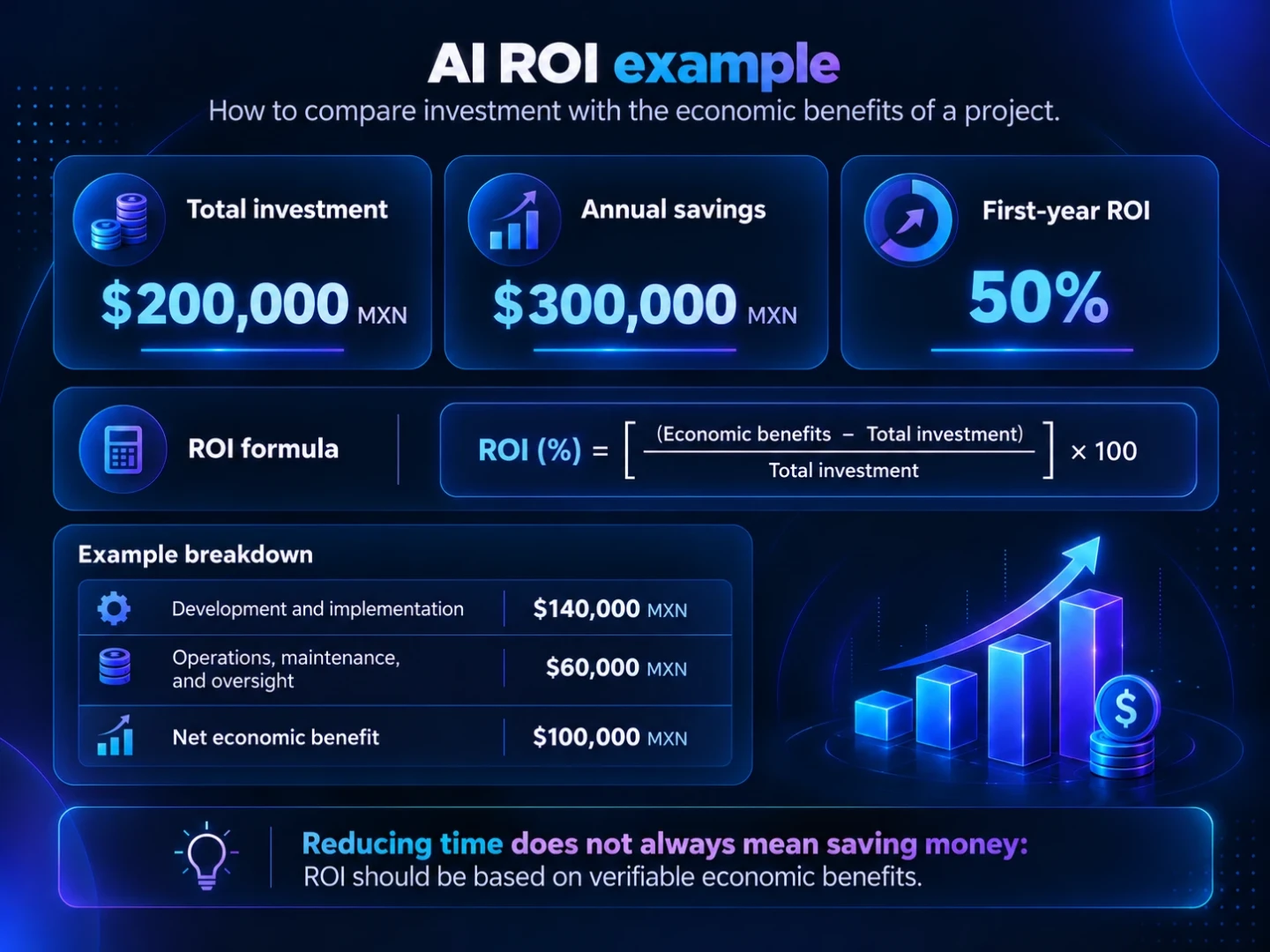
Suppose a company implements an artificial intelligence system to automate administrative tasks.
After one year, it records the following results:
Hypothetical example for illustrative purposes. Assumes the savings are verifiable and attributable to the project.
In this scenario, the company earns a 50% return on the resources invested during the first year. In other words, after accounting for project costs, it realizes a net financial benefit equal to half its investment.
However, not every operational benefit can automatically be treated as a financial saving.
If a tool reduces weekly work by ten hours but that time does not translate into lower expenses, greater productive capacity, or additional revenue, the company needs to determine how to assign an economic value to the improvement.
It is also important to recognize that ROI can change over time. Implementation costs tend to be concentrated at the beginning, while licensing, processing, and maintenance expenses may continue for years.
That is why, in addition to initial ROI, it is worth evaluating the payback period and preparing projections based on different usage scenarios.
How to Improve the Profitability of AI in Your Business
The problems outlined above show that increasing the budget for artificial intelligence does not guarantee better results.
Profitability depends on selecting the right opportunities, preparing the technology infrastructure, and establishing ways to measure the performance of each initiative.
Before approving a new investment, an organization should be able to answer specific questions: What financial problem are we solving? What does it currently cost? What benefits do we expect? How will we verify the results? And what will happen if the project fails to meet its objectives?
Actual operating costs should also be reviewed regularly.
A project that initially delivers positive results can become less profitable if infrastructure consumption rises, suppliers change their commercial terms, or new maintenance requirements appear.
The neocloud situation reinforces the need for this kind of evaluation. Their financial challenges show that even an industry with growing demand can struggle to recover capital investments.
Companies buying AI services should also review supplier dependency, data portability, and whether their technology architectures can adapt as the market changes.
The difference between implementing AI and capturing value from it lies in the ability to connect each project to verifiable financial results and sustain that profitability over time.
BluePixel: Turn Your AI Investment Into Measurable Results
An AI implementation may struggle to become profitable for reasons that are not necessarily related to model performance.
Integration gaps, operating costs, poorly defined processes, and adoption challenges can limit the benefits of a technically functional solution.
At BluePixel, we help companies identify these obstacles before making further investments.
Through our enterprise AI consulting services, we assess processes, data, and technology architecture to identify opportunities and prioritize initiatives according to their potential financial impact.
We also develop AI agents and automation solutions that connect with existing systems to perform tasks, share information, and improve operational efficiency.
Identify What Is Limiting the Return on Your AI Investment
If your company has already invested in artificial intelligence but is not seeing the expected results, it is important to determine where resources are being lost and which projects have the greatest potential to become profitable.
At BluePixel, we can help you assess your initiatives and determine what is needed to turn them into functional, measurable solutions aligned with your business goals.
Contact BluePixel and tell us what problem your company needs to solve.