
problem.
You've probably heard the famous phrase: “Artificial intelligence is going to transform every industry.” And yes, the evidence is all around us, from generative models to autonomous agents that handle entire processes, but the day-to-day reality inside companies is often quite different.
That may well be true, since the signs are everywhere: from generative models capable of producing content (videos, images, voices, etc.) in seconds to autonomous agents that can execute entire processes within enterprise systems.
While major tech companies release new developments every week, business leaders are asking the million-dollar question: How do we turn all of this into real business results?
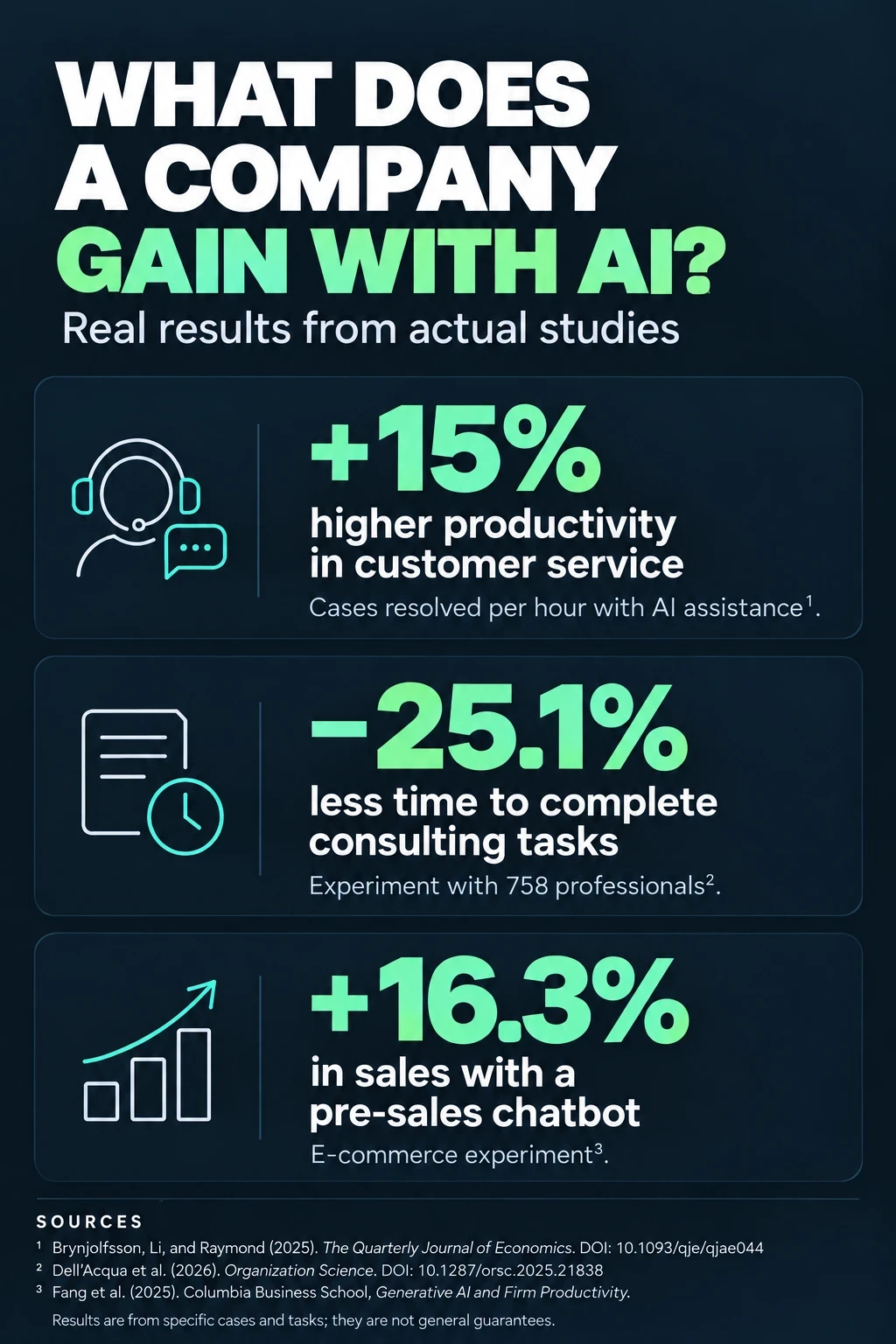
According to McKinsey's The State of AI report, although AI use is growing by leaps and bounds, companies still struggle to generate consistent economic value. The challenge is no longer accessing the technology, but knowing how to integrate it into core processes and decision-making.
Many organizations rush to test pilots, create trial assistants or develop AI agents, but let's be honest: most of these experiments fall by the wayside without affecting the company's bottom line.
The problem is almost never the models or a lack of technical talent; the real stumbling block is the disconnect between technology and business strategy.
In other words, organizations end up implementing artificial intelligence before understanding exactly what problem they need to solve. That's why we've listed the key phases for “reaching the finish line” with a clear direction…
Phase 0: Before implementing AI, make sure it's really the solution you need
Not every problem can be solved with AI. Imagine a company where the sales team has to enter the same data into three different systems. Management's first idea might be to create an AI agent to automate data entry. However, after a thorough analysis, they discover something surprising: they didn't need AI; they needed to connect their systems through APIs.
After several weeks of analysis, an unexpected conclusion emerges: the real cause of the problem wasn't a lack of artificial intelligence, but the absence of integration between systems. The difference is enormous.
Good integration solves the headache in weeks, while trying to add a layer of AI to a broken process only makes things more complicated and multiplies costs.
This happens all the time:
- Companies that want agents when what they need is data governance.
- Organizations looking for automation when what they need is to redesign processes.
- Leadership teams talking about AI when they're actually facing technology architecture problems.
That's why more mature organizations start with a strategic assessment, not a selection of tools.
Phase 1: Build a business case before building a solution
A classic mistake is assuming that technology will magically deliver benefits. Initiatives that genuinely create value start with a clear financial goal, not just technical enthusiasm.
Let's look at the difference between these two approaches:
- Tool-centered approach: “We want to integrate AI agents into the finance department.”
- Return-centered approach (ROI): “We want to reduce the time analysts spend consolidating data by 35%, projecting annual savings of $120,000 USD.”
The second approach lets you measure success, calculate returns and justify every cent invested. AI adoption in companies only works when it moves the needle on key business indicators (KPIs).
This means that before thinking about language models, agents or automation, an organization should answer much more fundamental questions:
- What is the current cost of the problem?
- How many people does it affect?
- How much time does it consume?
- What happens if it isn't resolved?
- What would be the economic value of eliminating it?
Without these answers, any ROI calculation will amount to little more than an optimistic estimate.
Phase 2: Identify the operational friction consuming time, money and growth capacity
Companies don't lose ground because of one major failure, but because of small daily inefficiencies. That operational friction is the sum of bottlenecks that build up throughout the organization.
In digital transformation projects, it's common to discover that teams spend a surprising amount of time searching for information, gathering documents, manually updating systems or coordinating activities that could be carried out far more efficiently.
When we support digital transformation projects, it's extremely common to find invisible drains on time:
- 15 minutes searching for a disorganized document.
- 20 minutes putting together reports manually in Excel.
- Entire days waiting for routine approvals.
Organizations that achieve better results with AI tend to be especially rigorous about identifying these sources of friction before deciding what to build.
Phase 3: Assess digital maturity before talking about agents, RAG or automation
Many AI projects end up becoming data organization projects, because artificial intelligence will only be as good as the information you give it.
If you want to implement an agent to answer questions about internal policies, but the company has seven versions of the same procedure scattered across SharePoint, emails and PDFs, the system will get confused. The challenge here isn't AI; it's organizing the organization's knowledge.
That's why an assessment of AI Readiness often yields extremely valuable discoveries before a single line of code is written. Not because AI doesn't work, but because it helps reveal how prepared an organization is to take advantage of it.
Phase 4: Prioritize use cases based on financial impact, not technological enthusiasm
One of the reasons so many artificial intelligence initiatives fail has nothing to do with models, data or technical capabilities; it has to do with how organizations decide where to invest.
Sometimes companies build their AI strategy by looking only for the most eye-catching option. This often leaves them with entertaining pilots, but no economic impact. That's why, in enterprise AI consulting firms, we help prioritize initiatives that compete for budget based on clear metrics and returns.
To hit the mark, it helps to assess three key aspects using a simple matrix:
- Financial impact: How much does it help increase revenue or cut costs?
- Technical feasibility: How organized and accessible is the necessary data?
- Ease of adoption: Is the team ready to integrate it smoothly into its workflow?
When an opportunity scores well across all three dimensions, it typically becomes a candidate for early investment.
It's important to consider that enterprise AI rarely fails for lack of ideas. The real challenge is deciding which ones deserve to become projects.
Phase 5: Design governance before deploying AI
There's a very interesting moment in practically every enterprise AI project. At first, it's all technical excitement: Will we use OpenAI, Anthropic or Gemini? But as the project takes shape, fundamental operational questions arise: Who's accountable if the model makes up a fact? How do we protect confidential information? Who audits the results?
Governance isn't there to create obstacles, but to provide the security an organization needs to scale. Think of it this way: managing a test bot is easy; connecting dozens of agents to your finance and sales systems requires clear rules from day one.
Phase 6: Design for adoption, not just functionality
You can build a technically perfect tool, but if your team doesn't trust it or finds it cumbersome, they'll ignore it. Adoption depends not only on technology, but also on trust, context and user experience (UX).
Think of a legal department where lawyers have spent years reviewing contracts manually. From a technological perspective, implementing an assistant that can analyze clauses and identify risks seems like a logical decision. However, the critical variable isn't the system's accuracy, but whether lawyers trust its recommendations enough to incorporate them into their daily workflow.
As Microsoft notes in its Work Trend Index study, the most successful solutions are those that integrate naturally into the channels people already use every day (such as Slack, Teams or your CRM), enhancing what they already do instead of forcing them to change their entire routine.
For this reason, the most successful implementations typically devote considerable time to prototypes, user research and early validation.
They aren't just trying to answer a technical question: Does the solution work?
They're trying to answer a much more important question: Will people actually want to use it when it becomes part of their daily work?
The difference between these questions is enormous: a technically functional solution can be deployed, but an adopted solution can transform an organization.
Phase 7: Integrate artificial intelligence into real business operations
There's a fundamental difference between an artificial intelligence demonstration and an enterprise capability: a demonstration answers questions, while a capability transforms processes.
A demo answers questions; a well-integrated solution transforms operations. The true potential is unlocked when AI connects directly to business systems (ERP, CRM and databases).
An agent that answers basic queries is helpful, but an agent backed by RAG (Retrieval-Augmented Generation) technology and the MCP protocol that can query SAP, update Salesforce and automatically trigger processes completely changes a company's productivity.
This is why concepts such as private RAG, multi-agent architectures, integration through MCP and system orchestration have gained so much relevance in business discussions. The debate is no longer exclusively about how intelligent a model is, and increasingly focuses on how connected it is to the organization's operational reality.
Companies don't buy artificial intelligence to chat with it, but to execute their strategy more effectively. And that only happens when the technology becomes part of the processes that generate economic value.
Phase 8: Measure results, evolve capabilities and build a sustainable competitive advantage
Organizations that truly derive value from artificial intelligence understand that deployment is only the beginning.
The reason is simple: implementing AI doesn't automatically produce results. Results come from the ability to continuously measure, learn and evolve based on its use.
Launching the tool is just the starting point. Tracking vanity metrics (such as the number of chats opened) proves nothing. You need to look at the numbers that matter to the business:
- Time savings: Hours freed up for higher-value tasks.
- Operational speed: Reduced response or cycle times.
- Reduction in costs and human errors.
- Measurable return on investment (ROI).
Companies leading this transformation understand that artificial intelligence must be evaluated with the same rigor as any other strategic investment.
A successful agent isn't the one that generates the most conversations, but the one that reduces resolution times.
A successful copilot isn't the one that produces the most content, but the one that improves the productivity of key people.
A successful automation isn't the one that eliminates the most tasks, but the one that generates the greatest economic impact.
When measured objectively, artificial intelligence stops being an isolated experiment and becomes a lasting competitive advantage. Success comes when a company learns to identify and seize new AI opportunities more quickly than the competition.