



In today’s web development landscape, few roles are as versatile and in demand as the full stack web developer. Companies need people who can understand the user experience, write the interface, design server-side logic, and connect everything to databases and cloud services. But what exactly does a full stack developer do, what skills do they need, and what role do they play inside a web development company?
In this article, we explain what this profile involves, what their main responsibilities are, what they study, which tools they use, and how artificial intelligence is impacting their work.
What Is a Full Stack Web Developer?
A full stack developer is a professional who masters both the frontend (what the user sees and interacts with) and the backend (the part that processes data and makes the application work “behind the scenes”).
Unlike profiles focused only on the interface or only on the server, a full stack developer has an end-to-end view: they understand how information travels from the user’s screen to the database and back. That ability to move between layers makes them a natural bridge between design, product and technology, and explains why they are one of the most sought-after profiles in web development companies and digital product teams.

What Do They Do and What Are Their Responsibilities?
A full stack developer’s day-to-day work varies depending on the project, but it usually covers the entire lifecycle of a web application. They take part in defining requirements together with product managers, clients and designers; translate those requirements into concrete features; and are responsible for both the visual side and the internal logic that makes those features work.
In practice, a full stack developer designs and builds new functionality on the frontend and backend, creates and consumes APIs to connect the application with other systems, models and queries databases, writes tests, fixes bugs, and works continuously to improve performance and security. They also support deployments to production environments and monitor how the application behaves in order to detect bottlenecks or points of failure.
In an agency or web development company, they may be involved in corporate sites, e-commerce platforms, dashboards, booking systems or internal portals. In every case, their core responsibility is to ensure the product works coherently end to end and can evolve over time without breaking.
Essential Skills of a Full Stack Developer
Frontend: where the user experience lives
On the visible layer, a full stack developer needs to master the foundations of web development: HTML for structure, CSS for visual design, and JavaScript for interactivity. On top of these foundations sit frameworks and libraries such as React, Vue.js or Angular, which make it possible to build dynamic interfaces, reusable components and smoother experiences.
Here, it’s not enough for “the page to load”. A full stack developer needs a feel for user interface (UI) and user experience (UX): thinking about visual hierarchy, readability, accessibility, load times and consistency with the brand identity.
Backend: logic, data and architecture
On the backend, the full stack developer is responsible for the business logic: what happens when someone signs up, logs in, makes a payment or checks their history. To do this, they typically work with languages like JavaScript/TypeScript (Node.js), Python, PHP or Java, and with frameworks such as Express, Django or Laravel.
They also work with relational databases like MySQL, PostgreSQL or SQL Server and, in some projects, with NoSQL solutions such as MongoDB. A key part of their job is defining data models, designing clear and stable APIs, and making sure the application is secure, scalable and maintainable as the number of users or features grows.
Tools, ecosystem and soft skills
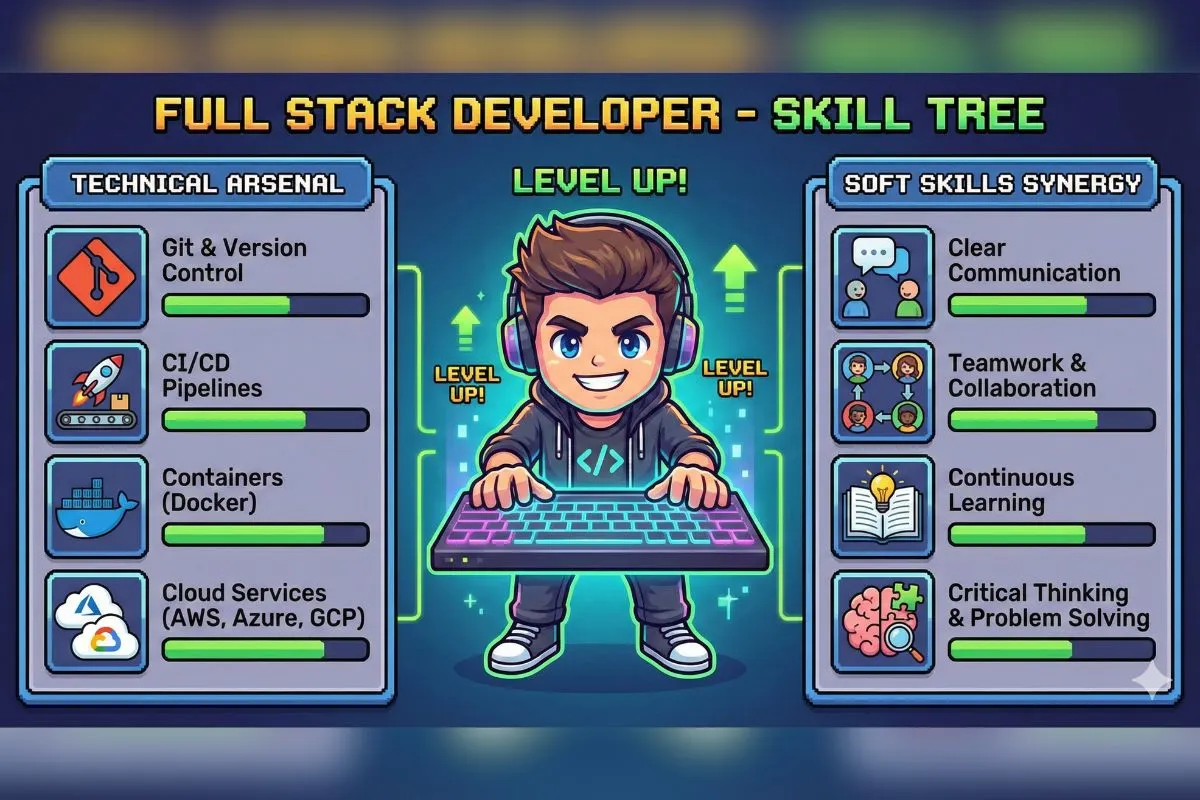
Beyond the code itself, a full stack developer works daily with tools like Git and version control platforms, continuous integration and delivery pipelines, containers such as Docker, and cloud services (AWS, Azure, Google Cloud, among others) to deploy and scale applications.
However, success in this role doesn’t depend only on the technologies they master. They also need clear communication with clients and non-technical colleagues, the ability to work as a team with design and product, curiosity to keep learning, and critical thinking to prioritize and solve problems. This blend of technical skills and soft skills is, in fact, one of the reasons why the full stack role is so valuable within a team.
Training, Career Path and Job Prospects
There isn’t a single path to becoming a full stack developer. Many people come from degrees such as Systems Engineering, Computer Science or Software Engineering; others arrive via web development bootcamps or in a self-taught way, relying on online courses, official documentation and personal projects.
Beyond the diploma, what carries the most weight when looking for a job is a strong portfolio: real projects, well-organized repositories, and the ability to explain how specific problems were solved. With that foundation, each professional can then focus on particular tech stacks (for example, React + Node.js or Vue + Django) or specific types of projects, such as e-commerce, SaaS or internal platforms.
When it comes to salary, factors such as experience level (junior, mid, senior), country, type of company (startup, agency, corporate) and the possibility of working remotely for other markets all come into play. The overall trend, however, is clear: as a versatile profile that can add value at multiple stages of development, demand for full stack developers remains high and offers good prospects in the medium and long term.
Full Stack and Artificial Intelligence: Threat or Opportunity?
With the rise of artificial intelligence, it’s natural to wonder: is AI going to replace full stack developers?
For now, reality points in another direction. AI tools are already part of the daily routine in many teams: they help generate code snippets, create automated tests, document functions or prototype interfaces more quickly. They also make it easier to integrate advanced capabilities into projects, such as chatbots, recommendation engines or text and image analysis via APIs.
What AI still doesn’t do—and is unlikely to fully do—is understand business context, make architectural decisions, prioritize features, negotiate scope or coordinate with people from different areas. That’s where the judgment, experience and soft skills of a full stack developer remain irreplaceable. Rather than a direct threat, AI is shaping up as a powerful tool: developers who learn to use it to automate repetitive tasks, explore solutions and improve code quality are precisely the ones who will stand out in the coming years.
Why the Full Stack Profile Will Remain in Demand
The full stack web developer combines something the market values more and more: a holistic view, technical capability and flexibility. They can understand the interface, the user experience, the business logic and the infrastructure that supports everything—and on top of that, they can speak the language of design, product and business.
In an environment where technologies change quickly, projects are increasingly complex and artificial intelligence accelerates the pace of development, full stack profiles that maintain strong fundamentals, keep their stack up to date and strengthen their soft skills will not only remain relevant, but will be in a privileged position to lead the creation of the next generation of digital products and services.


.png)