


Headless architecture is a key trend in modern web development, especially in the fields of content management and e-commerce. It represents an evolution of the traditional model, offering greater flexibility, performance, and scalability.
What Is Headless Architecture?
What Does “Headless” Mean?
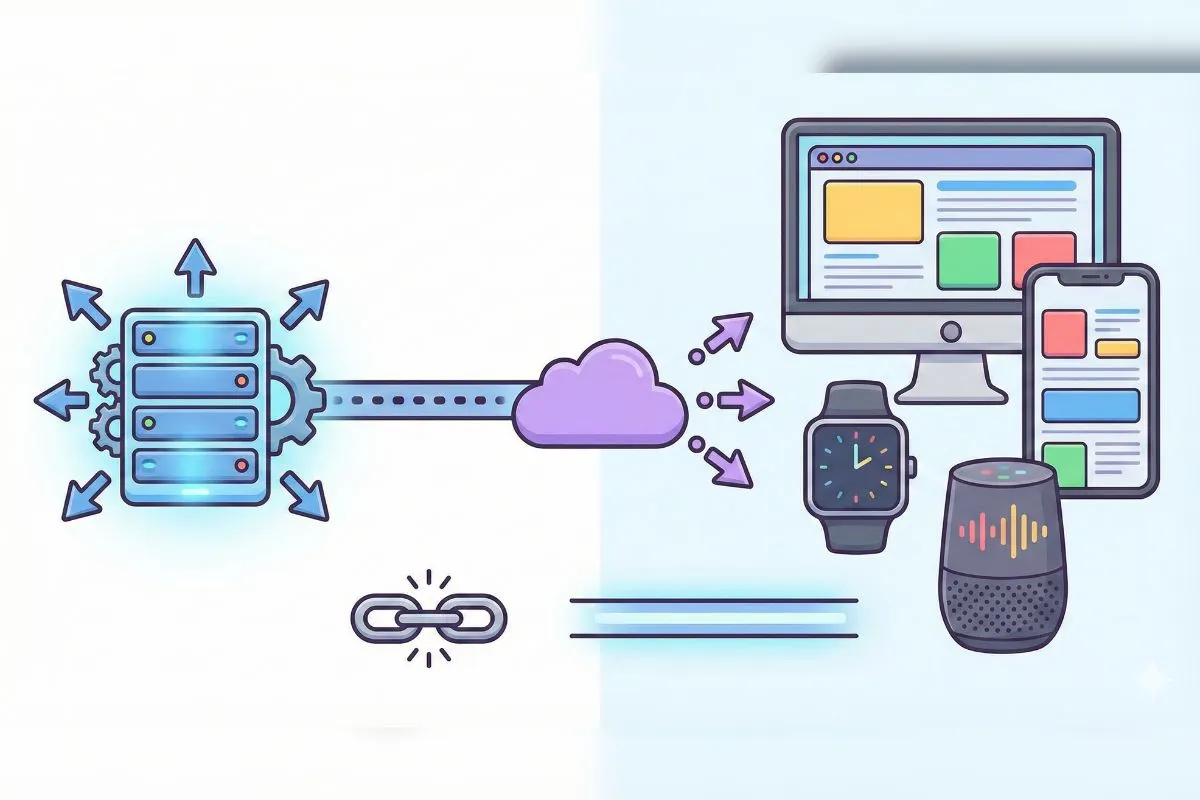
In technology, “headless” refers to a system where the visual part (what you see on the screen) is separated from the part that stores and organizes the information.
How Does a Headless Architecture Work?
In this type of structure, the system that manages the content (called a Headless CMS) is responsible only for:
- Storing the content (texts, images, data).
- Sharing it with other platforms through connections called APIs, which act like “bridges” to send information.
Then, the visual part (the frontend) takes that data and displays it on any device: a website, a mobile app, a smartwatch, a digital display, etc.
Headless vs. Traditional Architecture
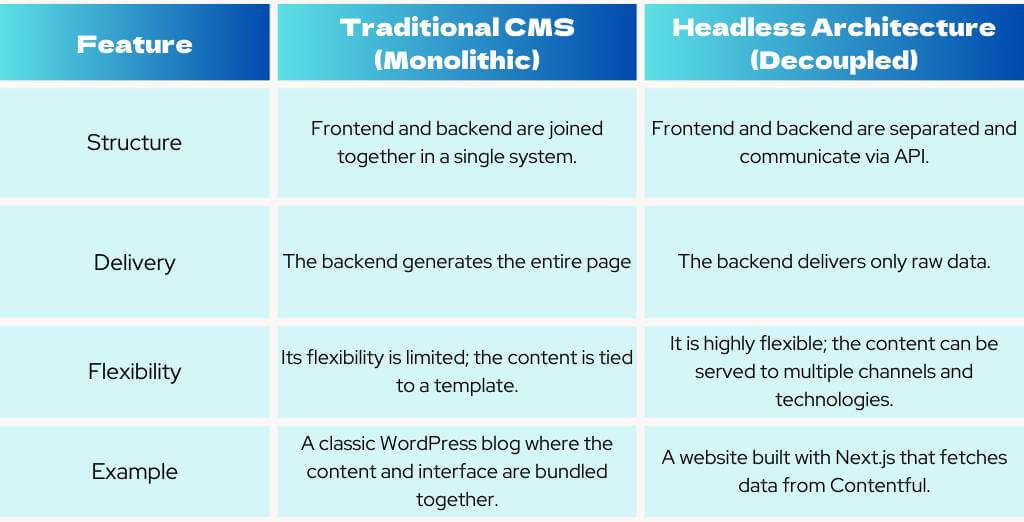
The difference between headless and traditional architecture lies mainly in how the layers are coupled.
Main Advantages of Headless
The separation of frontend and backend offers significant benefits that drive its popularity:
- Platform flexibility: This is the biggest advantage. By delivering content through an API, you’re not limited to a single website—you can use the same content for your web page, mobile app, IoT devices, and more.
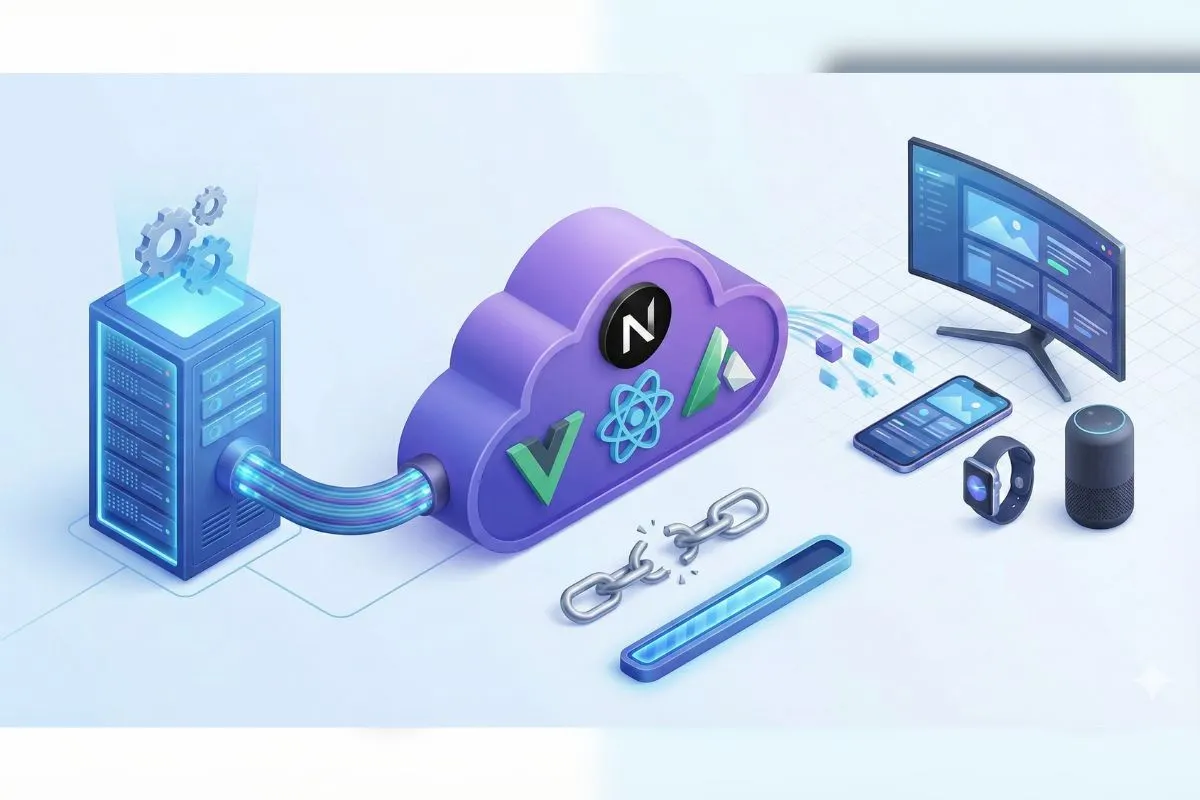
- Performance: The frontend can be built with modern technologies like React, Vue, or Next.js, which are extremely fast. This improves User Experience (UX) and SEO.
- Scalability: The layers can scale independently. If your frontend needs more capacity to handle traffic spikes, you can scale it without affecting the backend.
- Better developer experience: Developers can choose the tools and frameworks that best fit their needs and expertise, encouraging the use of technological best practices.
- Security: By exposing only the API to the public (and not the CMS’s entire database), the attack surface is reduced, making the system inherently more secure.
Implementing a headless architecture requires highly specialized teams and solid processes. That’s why working with certified professionals ensures that every stage of development meets international standards of quality, security, and scalability. At BluePixel, our certifications—Scrum Master for agile methodologies, AWS for robust cloud infrastructure, and CyberVadis for cybersecurity—ensure that your project is executed with an efficient, secure, and results-oriented approach. This translates into faster delivery times, stable platforms, and digital solutions ready to grow without compromising the integrity of your data.
Most Common Headless Technologies and Tools
Implementing a Headless architecture requires combining technologies specialized in content management and user interface. Some of the most widely used technologies and tools are:
- Headless CMS
These systems focus solely on creating and storing content, exposing it through APIs.
- Contentful: A robust and scalable cloud-based (SaaS) service, one of the pioneers in this space.
- Strapi: An open-source, self-hosted CMS that allows developers to design their own APIs. It stands out for its flexibility.
- Sanity: Developer-oriented, known for its real-time querying system and focus on data management.
- Compatible Frontend Frameworks
This is the layer that consumes the CMS API and renders the user experience. JavaScript frameworks are essential here.
- Next.js (React): Considered a leader for fast web applications, it supports Server-Side Rendering (SSR) and Static Site Generation (SSG), and offers superior performance.
- Nuxt.js (Vue): The Vue.js ecosystem equivalent to Next.js, with the same advanced rendering capabilities.
- React and Vue: Used directly for Single Page Applications (SPA).
- Data Layer: APIs and GraphQL
This is the communication bridge between the frontend and the headless CMS.
- REST APIs: The most common form of communication.
- GraphQL: A query language that allows the frontend to request exactly the data it needs, reducing overhead and improving network efficiency.
- Headless E-commerce Platforms
In e-commerce, this architecture separates cart/checkout functionality from the digital storefront.
- Shopify Plus: Offers robust Storefront APIs, allowing you to use Shopify as the e-commerce backend engine and build a fully customized frontend.
- BigCommerce: Provides APIs that let you decouple the frontend and create highly tailored shopping experiences.
When applied to custom projects, Headless architecture makes it possible to design a backend fully aligned with each company’s business rules and connect it to multiple frontends or applications through APIs. This means the software can evolve modularly, integrate with external systems, update without interrupting operations, and scale specific functions without depending on a monolithic structure. For tailor-made developments, this architecture speeds up the rollout of new features and makes it easier for design and development teams to work independently, reducing both time and costs.
When Does It Make Sense to Use Headless Architecture?
Headless architecture is especially valuable in industries that require speed, personalization, security, and the ability to operate across multiple channels. Sectors such as retail and e-commerce, banking and fintech, healthcare, education, tourism, media, and companies with international operations take advantage of this approach to deliver omnichannel experiences, manage large volumes of content, and connect various internal systems. It is also ideal for brands seeking continuous innovation, sites with traffic spikes, and organizations that need to integrate mobile apps, corporate systems, and web platforms under the same flexible infrastructure.
Although it is not the ideal solution for small, simple projects, Headless is the preferred option for:
- High-volume e-commerce: Online stores that need extreme frontend customization and ultra-fast performance.
- Projects with multiple touchpoints: For companies managing a website, mobile app, employee portal, etc., all using the same central content.
- Large enterprises with diverse technology: For organizations that need to integrate content systems with CRMs, ERPs, and other enterprise tools.
If you’re ready to move to a modern infrastructure, optimize your e-commerce, or expand into multiple channels, Headless architecture is the path you should follow. At Bluepixel, one of the best web development agencies in Mexico, we help you implement it strategically so you can achieve superior performance and a solid digital experience.
Frequently Asked Questions About Headless Architecture
Is headless architecture more expensive than a traditional CMS?
In most cases, the initial investment can be higher due to the development of a custom frontend and the configuration of APIs. However, in the medium and long term it reduces operating costs thanks to its scalability, higher performance, and the ease of adding new features without rebuilding the entire system.
What types of companies should consider a headless solution?
It is ideal for businesses that need a high degree of customization, multiple touchpoints (web, app, kiosks, displays), dynamic content, or international scalability. Sectors such as retail, fintech, education, tourism, healthcare, and media tend to obtain significant benefits.
Do I need technical knowledge to manage a headless CMS?
Not necessarily. Although the architecture is more sophisticated for developers, content teams still use an intuitive interface to create and publish information. The complex work happens “behind the scenes,” where developers connect APIs and manage the infrastructure.
Is it more secure than a traditional CMS?
Yes. By separating the backend from the frontend and exposing only controlled APIs, the attack surface is significantly reduced. Additionally, you can add extra security layers such as access control, private endpoints, firewall rules, and certified cloud services.
Can I migrate from a traditional site to headless without losing content?
Yes. Migration is entirely possible and common. Content can be transferred to a Headless CMS through scripts, integrations, or structured imports. What changes is the way the frontend consumes that information, not the data itself.
Does it require more maintenance than a traditional platform?
Maintenance is different, not necessarily greater. The backend, frontend, and APIs are managed separately, which allows you to update components without affecting the entire platform. This makes it easier for the project to evolve without interruptions.
Does headless architecture improve site performance?
Definitely. By using modern, optimized technologies (such as Next.js, React, or Vue), your site achieves faster load times, a better user experience, and improved Core Web Vitals metrics, directly benefiting SEO.


.png)